Christmas Games for Families: Ideas for Mixed Ages
Play four Christmas games with ordinary paper, pencils or your voices, then plan a flexible family evening. Find complete rules, ways for non-readers to join and printable choices when you want supplied rounds.
Four Christmas games you can play without buying a pack.
Use ordinary paper and pencils, or just your voices. These are complete original activity ideas. No timer, prizes or purchases are needed; passing a turn is always allowed.
1. The Christmas picture relay
Bring: one sheet of paper and a pencil. Play: together, taking turns.
The first player draws a parcel. The next adds a place it might go. The next adds a character waiting there. With two people, alternate; with one adult and a child, draw together.
Take a second round: add a surprising delivery method, a small problem and something that helps. Agree who draws each addition before the pencil moves.
Finish by pointing to the six additions and telling the delivery story from start to ending. There is no correct picture or score.
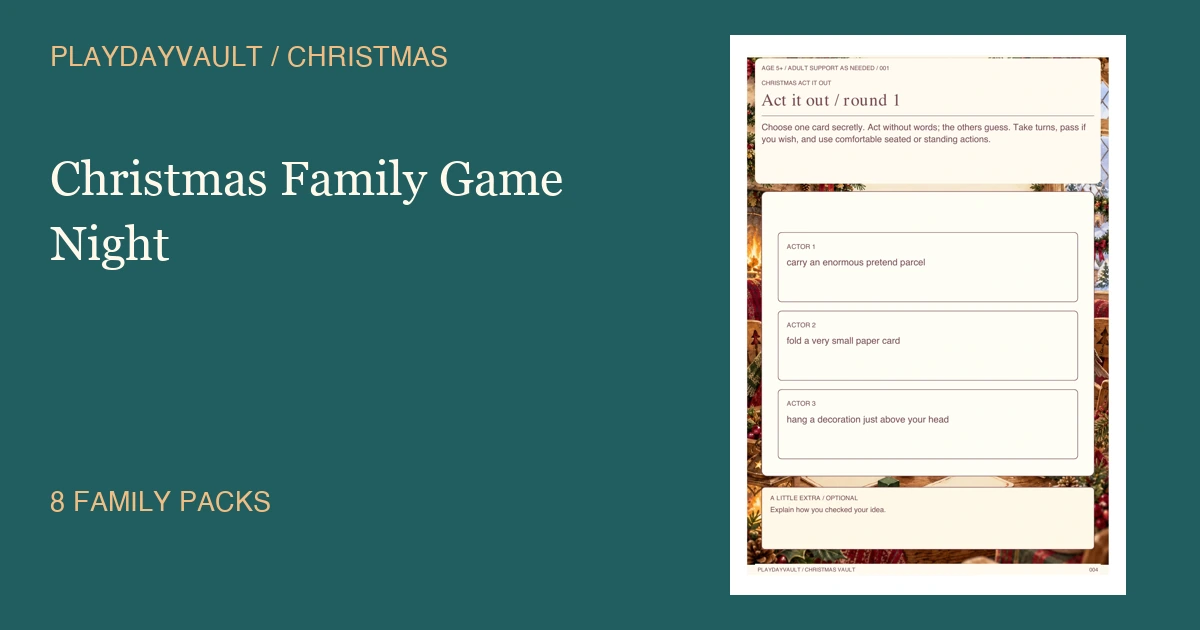
Help a non-reader: offer two spoken choices or let them direct another person’s drawing. For more supplied drawing, acting and conversation rounds, inspect Family Game Night’s eight packs.
2. Silent festive jobs
Bring: no materials. Play: one performer and household guessers, swapping roles.
A reader quietly gives the performer one pretend job: wrapping an empty box, hanging a paper star, opening a card or carrying a wobbly stack of parcels. Do not use real objects.
The performer acts without words. Guessers may ask for the action to be repeated. If nobody guesses, the performer names the job and demonstrates it together with a helper.
Offer everyone a turn, including the reader. Finish after each willing player has performed once. There is no fastest-player prize.
Adapt the action: play seated with hand or face gestures, or describe the action aloud if acting does not suit. Use the same help rule for everyone.
3. Pattern postcard exchange
Bring: a sheet and pencil for each pair. Play: pairs helping each other.
Choose two easy marks, such as a circle and a star. Draw circle–star–circle–star–circle, then leave a space. Keep your chosen repeating pair in mind.
Swap sheets. Add the next mark, then explain which two-mark unit repeats. The maker checks it against their chosen pair: the example needs a star.
Make one new pair-pattern for the other player to complete. Finish when each person has made and checked one. If a mark is unclear, redraw it together.
Help a younger player: point to the two-mark unit and name it aloud. Use shapes rather than colours so an ordinary pencil is enough. For a connected picture-pattern and route challenge, try the complete free Welcome Window mini-game.
4. Five-turn welcome story
Bring: no materials; paper is optional. Play: a shared story circle.
A reader announces five story turns: visitor, place, small problem, helper and welcome. Choose a gentle imaginary Christmas setting in winter, summer or any season you like.
Take one sentence per turn. For example, a toy bird visits a paper village, cannot read its invitation, meets a helpful cat and is shown a seat by the window. Build your own version rather than testing someone’s memory.
After the welcome turn, stop adding events. Retell the five parts together or draw the final scene. Different endings are welcome; there is no required answer.
Help a non-reader: let them choose a character, point to a drawing or dictate a sentence. For a larger library of supplied making and story choices, compare Carnival’s formats and reading support.
For example, begin with the shared picture relay above, offer a break, then choose either another short round or one complete printable game. Keep a quiet drawing option available. This is a suggested order, not a timed schedule or tested duration. You can stop after the first activity and still have played together.
Decide who is playing
Count the group, check the youngest reader and decide whether everyone wants a connected mystery or shorter rounds. Read the listed ages, player limits and difficulty. A family gathering may include confident puzzle solvers and first-time players, so choose a pace that allows both to contribute.
Choose a festive story or familiar family format
The Christmas collection links existing festive escape-room products, with their actual contents and previews. If your family prefers quizzes or creative rounds, browse the family-games collection too. Check the particular game instead of assuming every winter-themed product is a Christmas story or an Advent calendar.
Choose mixed play for different ages
Storybook Carnival offers fifty complete kits across five fairs. Start with a format: picture noticing, shared art or story invitations for ages 5+ with a reader; boards and branching stories start at 6+, codes, making and markets at 7+, and clue trails at 8+. Read the actual kit before choosing. Ten formats recur with different settings and evidence.
Prepare one Carnival kit
Use the parent finder to choose a format and setting. Open its start instructions, print one matching player edition and keep the adult guide separate. Many choices need paper and pencils; boards use a shared paper counter. Making choices use adult-supported scissors and optional glue or tape, with flat drawing alternatives. A household licence covers home play; it does not include a class or public event.
Print before the gathering
Download the correct paper-size edition and read the host guide. Print player materials, prepare any instructed cut pieces and keep answers separate. Do this while the table is quiet rather than trying to learn the rules during a meal. A digital download still needs preparation.
Adapt the occasion to your home
An indoor table works for a winter evening or an Australian summer Christmas. Choose a time when children are comfortable and adults can give the game attention. If you play outside, secure loose clue pages and keep drinks away. A festive story does not require snow, costumes or elaborate decorations.
Let hints and breaks keep the game moving
Agree on a host or shared hint method. Give younger players concrete jobs and rotate reading and recording. Pause when needed. Finish with a favourite clue or moment rather than judging the evening only by how quickly the final answer arrived.